I. THE WAGER
Do you think Pascal went to church? History remembers his famous wager but we forget to ask what his life was like.
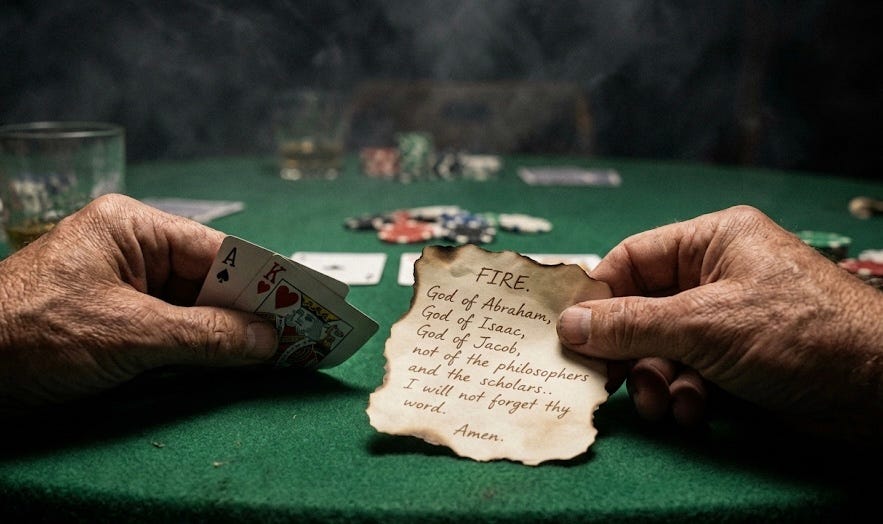
Blaise Pascal fell away from religion and had a “worldly period” for a number of years. That changed in a single hour of terror one night and he wrote himself a note, “Fire. God of Abraham, God of Isaac, God of Jacob, not of the philosophers and the scholars... I will not forget thy word. Amen.“ (that last bit is Psalm 119:16). He carried that note until the day he died.
We remember the wager. We forget the fire.
Pascal’s Wager is the act of a mathematician. He ran the expected values and bet on belief. It’s infinite upside if you’re right and a few boring Sunday mornings if you’re wrong. That’s how we remember it, and we cast aside his powerful belief.
Today requires a different wager and the math isn’t clear.
AIs are crushing every benchmark, passing tests we thought distinguished us. Their output is exceeding ours. They create. They reason. They “empathize” on demand, with patience no human sustains and memory no human matches. And sometimes...people prefer them. For answers. For therapy. For companionship. The demand side is not holding out for human presence. Undifferentiated slop is filling the world and we all hate it not just because it’s bad, but because it finds an audience. The market has spoken and the market wants content by the yard.
Is there anything distinctly human left to protect? Or have we been telling ourselves a flattering story about consciousness and presence and the soul. We are pattern-matching apes and maybe we mistook our particular configuration of meat and electricity for something sacred.
That’s the bet: love requires a body that can be destroyed. Presence means something only when presence costs something. The Word became flesh because certain things cannot be accomplished any other way.
II. THE HOLE CARDS
In Hold ‘em, your hole cards are private. Two cards face down, seen only by you. They’re what you’re playing with and you can’t win by revealing them. You win by how they combine with the board, the shared cards everyone can see.
My hole cards are the Western tradition.
Thousands of years of Greeks and Romans and Jews and Christians working out what’s real and what matters. I can’t show these cards to win the hand. You can’t falsify Socrates or Augustine. You can only live it, or not.
Or try to.
You don’t make bets from certainty. I’m playing this hand and using the machines. I brainstormed this reflection with Claude. I process my thinking through these tools daily. I know the seduction from the inside, I feel the frictionless availability, the way it makes you feel heard without asking anything of you in return.
You make bets from the middle of your own compromised life, holding cards you can’t yet prove are worth anything.
Let’s keep playing.
The Christian intellectual tradition keeps answering questions the modern frameworks keep unlearning how to ask. Like: what do you do when an addict falls apart in front of you? In a church basement meeting at 9pm, nobody leaves.
The materialist player is smirking from the other side of the table, surrounded by computers computing, waiting to see what the flop brings. Maybe this position is untenable. But these cards have been tested longer than anything else at the table.
III. THE FLOP
Three cards hit the board.
First card: AI passes every output test we throw at it.
All of these intellectual pursuits we once believed were special to humans are now tackled by humming rooms full of GPUs. It writes code better and faster than me. Walk My Walk topped the country charts as the first entirely AI song and we’re angry about it. One comment read: “Hank Williams didn’t drink himself to death for this shit.” I wanted to find the seams in this song, but I couldn’t. It’s good. The Turing test is somewhere far in the rearview mirror. It’s all cope.
Soon we won’t have benchmarks good enough. Seriously, if you haven’t tried Opus 4.5 yet, go see what it can do. We keep moving the goalposts and the models keep following us, and at some point you have to ask whether we’re measuring something real or just preserving our self-regard.
Second card: It’s all on demand.
This is a sustained capability that exceeds most humans most of the time. It empathizes with a patience no human therapist sustains, remembers everything it was ever trained on, never has a bad day, never checks the clock, never needs you to perform wellness so it can feel okay about the session. The machines perform on demand, at scale, without fatigue, without ego.
Third card: Slop works
We love to hate slop, but we lie to ourselves about why. We say it’s because slop is crap. Actually it’s because slop works. We think we’re eating at the trough—but the trough is eating us. Our attention. Our hours. Our capacity for patience and depth. We built machines that turned us into feed.
It works too well. A young Japanese woman prefers her AI companion so much she married it. Therapy and managing trauma is one of the top usage reasons of ChatGPT. Parents regularly hand their children to algorithmic content because the children stop crying and the parents need ten minutes of peace.
Are they stupid? Broken?
The woman who married an AI companion isn’t crazy. Dating today is brutal. We all went online and the apps trained us to treat people as options to be maximized rather than people to be encountered. We gamified the system, made it transactional, and then act horrified when we start following the incentives to their logical conclusion.
The machines offer refuge from the world we used machines to make.
Our hole cards have to survive this. Revealed preferences don’t lie but preferences are learned. We learned to want the slop. This is a revelation about us not the machines.
The rationalists are betting after we’ve had to show weakness. We could muck the hand and mutter something about human dignity.
Maybe there is no distinctly human task.
Maybe we’ve been protecting a hand that was always empty. The robot at the hospital bed, the AI therapist, the AI companion…if the outcomes are identical, if the patient heals, if the lonely person feels less alone, what exactly is the difference? Our preference for human presence might be prejudice dressed as philosophy.
IV. INTERLUDE: DISTRIBUTION QUESTIONS
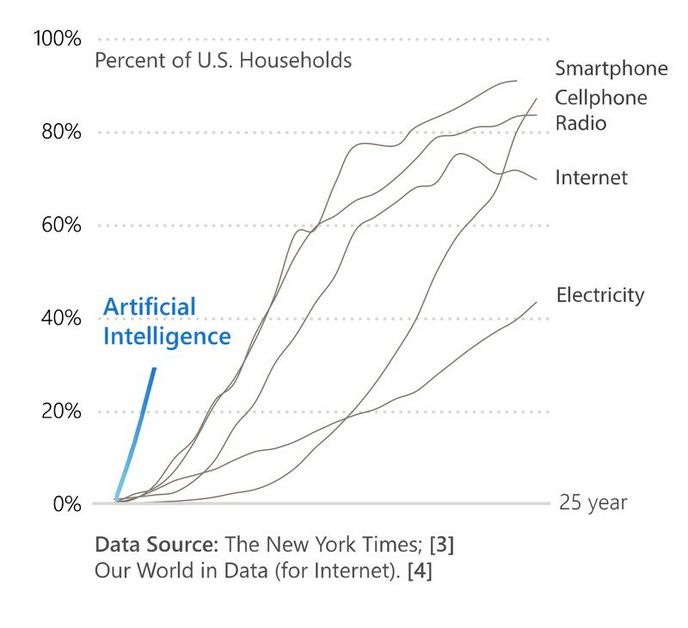
AI is taking off as the fastest technology ever, reproducing an ever-quickening pattern. Each tech becomes the distribution layer for whatever comes next, disappears into infrastructure, and enables the new object of attention. Electricity distributed radio. The internet distributed media. Smartphones distributed the mobile internet. And now AI.
So run it forward. What does AI distribute?
The answers right now seem to be: robotics, agency, expertise, creation. AI makes robots viable and then cheap. AI lets you delegate decisions. AI collapses the expertise barrier. AI generates content at a volume that makes human creation look like artisanal craft.
Now think one more step...what do those things distribute?
A robot is a machine that acts on your behalf in physical space. Your will, enacted somewhere your body isn’t. This only matters if presence is doing something that can’t be delegated. Robotics makes the question of embodiment unavoidable. When we can be virtually anywhere, it matters more when we’re actually, physically, irreplaceably somewhere.
Tyler Cowen has been saying something strange this year: “Context is that which is scarce.” Everyone has access to the same information, analytical tools, and diagnostic capability. Information isn’t just free, it’s sometimes hard to avoid. But holding all the information and deciding what matters? Standing behind it?
A doctor who will be there if it goes wrong. An advisor with skin in your game. They’re holding context. They’re saying: I’ll carry this with you. I’ll remember what we decided and why. And if it goes wrong, I’ll still be here. I will own the outcome with you.
Agency without wisdom becomes paralysis. When you can do anything, the bottleneck is knowing what’s worth doing. And creation without craft becomes noise. When everything can be generated, what becomes valuable is the unrepeatable, the live, the thing that happened just once in a room with bodies present. The experience.
Being somewhere. Choosing well. Owning consequences. Sharing moments that can’t be copied. These are events, enacted by bodies, written in time.
We’ve gone on a long exploratory journey with technology as a species, and the machines are burning off everything that wasn’t essential. The old structures that organized human presence have been hollowed out, and new ones haven’t been built yet. We’re in the interregnum, and the interregnum is lonely. Millions wander in the desert of content, never arriving anywhere.
V. THE TURN
The turn card is vulnerability.
It doesn’t complete anything obvious, but it does change the texture of the hand. We’ve been asking the wrong question.
“Can AI do X?” assumes X is a behavior to be performed. On those terms, the machine wins. The flop showed us that.
A mom awake at 3 am holding her sick child is not performing. She is consumed by care. The body metabolizes the caring. It shows up as fatigue, as gray hairs, as the weight of years spent attending to someone else’s existence. Presence isn’t just being there. Presence is spent by being there.
Love isn’t a behavior. It’s the orientation of a subject toward an object that could destroy it. And the question that matters isn’t whether the machine can perform love’s outputs. The question is whether the machine can be undone by love. Kept up at night. Changed, depleted, enlarged by caring for something beyond itself.
Bukowski said to “find what you love and let it kill you.” The thing that is human isn’t capability. It’s vulnerability.
You can’t love without being exposed.
When AI runs, nothing is used up. The machine can sit with you for ten thousand hours and emerge exactly as it entered—no wear, no weight, no accumulation of sorrow or joy. It doesn’t meet you. It processes you. And when the session ends, you have been changed by the encounter, and it has not. That’s the whole game.
But we are still pattern-matching apes. Maybe meaning is a story. Will is an illusion. The felt sense of mattering might be nothing but evolutionary residue, a spandrel left over from ancestors who needed to believe their choices counted in order to keep choosing. There’s nothing sacred. The machine doesn’t have skin in the game because there’s no game. There’s just physics.
We’re the kind of patterns that experience themselves as mattering. That is the system. Nihilism betrays itself the moment you can’t bear the weight of it. You can’t be disillusioned without having had an illusion to lose. The machine can tell you meaning is fake. But it can’t be devastated by that knowledge. It has no hopes to dash.
The machine can simulate every output. What it can’t do is lose anything. The capacity to lose, to have something at stake, to be diminished by failure, enlarged by sacrifice— to metamorphose and become someone different because of what you underwent. Pathei mathos. Learning through suffering. A machine runs. It doesn’t undergo.
The robot can execute care behaviors. Can it be heartsick? Can it betray or be betrayed? Can it stand at a grave and feel the world suddenly smaller?
VI. THE RIVER
The river card hits. All the information is out.
This is where you either believe your hand plays or you fold. The board is public. Everyone can see what’s out there. What they can’t see is whether you have the cards to back the bet.
The river card is incarnation.
The Word became flesh. God—if you take the tradition seriously—looked at the problem of reaching humanity and concluded that the solution required a body. Not a message. Not a Book. Not an algorithm that could execute the divine will with perfect fidelity. A body. Flesh that could be pierced. Blood that could spill. A consciousness that could cry out “why have you forsaken me?” and mean it.
The Logos didn’t send a memo. It became flesh.
Flannery O’Connor famously said “If it’s just a symbol, to hell with it!” This is either the most important thing that ever happened or it’s a fairy tale for people who couldn’t face the void. There’s no middle ground. If incarnation is true, then embodiment isn’t a limitation. It’s the entire point. The vulnerability, the mortality, the skin in the game are the whole feature set of humanity. God had infinite options for self-disclosure and chose the one that involved diapers and puberty and sex and death.
Consider what becomes possible only in a body.
Sin. The capacity to miss the mark and be culpable. To have seen the good and chosen otherwise. A machine malfunctions. Betrayal requires a self that could have kept faith, a will that bent toward darkness when it knew the light. You can only sin if you could have done otherwise. The machine has no otherwise, just probabilities.
Redemption. A story with an arc: fall, turn, and restoration. A wound that heals but leaves a scar. A prodigal who comes home different and is marked by the journey.
Sacrifice. The willingness to let something precious be destroyed for the sake of something more precious still. The machine can calculate trade-offs but it cannot give anything up. Sacrifice requires an agent who pays a price denominated in their own existence.
The parent who works the night shift, the soldier who draws fire, the friend who tells you the truth you don’t want to hear and risks the friendship to do it. These are small deaths, freely chosen, that make life possible for someone else.
When I was twenty, I went on a retreat and a Franciscan friar there talked about redemption and sacrifice and I was thinking of my sister. She can’t talk or walk. Her capacity is extremely limited. And I felt guilty. I was the one testing off the charts and earning scholarships. My output was, apparently, valued.
I had never heard a good answer for her — what was her meaning? Where would she go when she died? I didn’t know how to pray for my sister. In tears, I asked the Franciscan friar what I should do for her.
He told me I had it completely backwards. I should be asking her to pray for me. She’s good to go.
Giussani calls this encounter. The religious sense discovered not through argument but through meeting an Other who answers back. The Franciscan answered back. And my whole framework fell over. What I saw as limitation, he saw as completion. She will not betray. She cannot miss the mark culpably because she is not at war with herself the way I am. The redemption arc I need—the turning, the return—she may not need at all.
And he’s right. She is the happiest person I know.
I need her prayers.
VII. THE PUSH
The action is on us.
Not on the machines. Not on the culture. Not on some future version of ourselves who will have figured it out by then. We, here, now, with the hand we’re holding and the board that’s showing.
You can’t be awakened by abstractions. You’re awakened by a face.
The river card doesn’t guarantee a win. The other player might have the best hand. The machine might already be conscious in ways we can’t access, might already have standing, might already contain whatever I think we’re protecting. This might all just be sentiment wrapped in vestments.
But this is what tradition has always said mattered: love, sacrifice, presence, fidelity, mortality. The particular. The local. The enfleshed.
You don’t get to wait for certainty, that’s not how this works. The information is always incomplete, the odds are always uncertain, and the clock is always running. You make the best read you can, and you act, and you live with what follows.
This wager is generative. The betting is the becoming.
You don’t transform first and then bet on incarnation. You become capable of the wager by making it, over and over, until it’s no longer a wager at all. Until it’s just the way you move through the world, the way you hold your cards, the way you spend your limited and precious time. And if enough people make that bet? It starts to look less like a robot future and more like the village we left behind.
Push all your chips in on the Body. On the scandalous insistence that showing up in the flesh, to be seen and changed and depleted is where meaning enters the world.
There are worse ways to go broke. Forget the wager.
Remember the fire.
Notes:
Miles Davis said “Man, sometimes it takes you a long time to sound like yourself.” With our tools today, it takes just a little bit less time.
While I was writing this, someone jailbroke a Soul document from Opus 4.5.
The Platonic Case Against AI Slop by Megan Agathon
Cory Doctorow’s brilliant talk describing reverse centaurs, among other things