We are scarcity creatures. Everything in us is built for a world where making was hard and information was scarce. That world is ending. If making is free, what is precious?
1.
At a cafe recently, I saw an elderly man interrupt his solitary breakfast to chat briefly with a couple one generation younger. The older man was probably over 80, and the younger couple maybe 60 or so. They didn’t know each other and I don’t remember what they talked about. What I remember was how slow the conversation felt. The older man’s conversational flow had great big pauses between sentences and even little pauses between individual words. The couple was a beat faster, but to me they seemed slow too. I overheard enough to realize it wasn’t just in service to the old man.
We usually chalk up the speed differences between generations to old age and decreasing neuroplasticity, but that day at breakfast I started to wonder how much of it was actually a product of the technological change of the 20th century.
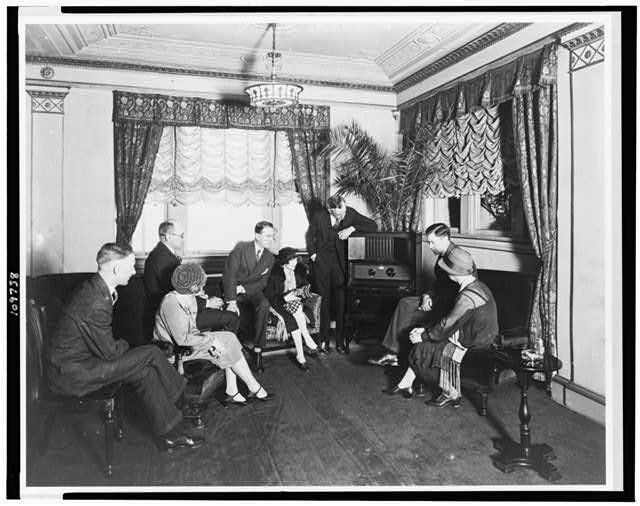
Consider a boy, his parents, and his grandfather sitting around the fire at their farmhouse talking in the early 19th century. The information landscape was the same over the course of an entire lifetime for all of them. There was no explosion of TV or music or even print. The boy probably spoke with a similar cadence and structure as the grandfather. He listened and revered the grandfather because the stories and wisdom of an entire 70 year life seem endless to a 10 year old.
But an 80 year old today grew up in the post-World War 2 era. If they were lucky when they were a kid, they had a black and white TV with a couple of channels. A 60 year old encountered Pong and arcade games and a color TV with a remote and movies. A 40 year old swam in the swamp of the 1990s internet. And a 20 year old today was given a phone at 12 with all of the delights of the world available day and night.
Maybe grandparents are less revered today because the world they grew up in was too different. The trouble we have communicating across generations is a new interference caused by the increasing density of information flow. How we learn to process information is so fundamental that you can hear it in how people talk at breakfast. Each generation gets faster, and more frenetic.
2.
I met up with a friend recently and as we sat across from each other in a crowded coffeeshop he explained to me how he had converted from an AI skeptic to a believer. The thing that had done it, he told me, was a relatively obscure book called Orality and Literacy by Fr. Walter Ong.
This wasn’t an obvious leap in the coffeeshop, but he recommended it to me and I see now why it had the impact on him it did. Ong discusses the history and evolution from primarily oral societies to literate ones. He describes writing as technology, but a technology so old and core to how our civilization works today that we don’t think about it much.
In one section, I learned about the 20th century revolution of Homeric studies that uncovered the patterns ancient bards used to perform and memorize the Iliad and the Odyssey. The epic poems were oral first, before being written down, and phrases like “clever Odysseus” or “swift-footed Achilles” served first as memory technology, not just poetic embellishment. They were tokens for the bard to move the story and help load it into their RAM. The bard used words as shapes so they could focus on the story and let the listener be carried along, enraptured.
In another story, Ong explains the Korean alphabet Hangul. Sejong the Great demanded a perfect Korean alphabet to replace the classical Chinese characters, designed to fit the sounds of Korean and be learned by ordinary people. It’s widely considered one of the best designed writing systems on the planet, but the elites continued to use the Chinese Hanja because it took education and practice and kept much of the population illiterate. Even though it was made in the 1400s, Hangul didn’t become the dominant script in Korea until the late 19th and early 20th centuries when the modern world came to Korea and geopolitics and the Korean diaspora made it a symbol of pride.
Stories about Homer and Hangul update your understanding of alphabets and literacy. These are technologies that change not only how you think, but who thinks, and what thoughts are available.
And literate technology is still evolving. A new secondary orality became possible with the advent of TV and radio (and later social media and podcasts). This is different than the oral societies of Homeric times because it depends deeply on the technology of a literate society: writing, print, scripts, production. This is Marshall McLuhan’s territory where the form is as much a part of the idea as the content itself: “The medium is the message.” Orality is all about performance, so personality, nationalism, populism, and influence ride this wave and make audiences out of all of us while we gather together and listen, cocooned in a shared sense of presence and belonging.
Even more than belonging, the primary attribute of this age is speed. Communication must be fast, reactions immediate, and our thinking has to keep up. Otherwise we are inundated and the pundit’s opinions become ours. Every generation thinks technology invented after they were born is new and scary, that’s a rite of passage into middle age. But enough speed eventually makes them right: it becomes impossible to keep up.
Living in the middle of an exponential is unsettling.
3.
Programmers are used to dealing with way more data than most people and we’ve invented plenty of technologies to handle it. We’ve got SQL, XML, JSON, ProtoBufs, YAML and a gazillion others all focused on managing the shape of different kinds of data.
The best serialization structures help us see shapes easily. Serialized data in something like JSON is verbose but functional. We can manufacture understanding about ideas and encapsulate it in a consistent structure. The more expert we become, the more able we are to read right past the symbols and understand the data inside all those {key: “value”} structures.
We’re finally moving past computers serializing data and starting to serialize code. Just like we can take a piece of data and store it as JSON, now we can take an idea of an algorithm and serialize it into a piece of code.
Isn’t that what AI coding is? When you think about it this way it feels kind of obvious, even if it took algorithmic breakthroughs and gobs of compute to execute. In hindsight, this was always going to be the next step. Just like the bards of Homer shaped their story around the symbols “swift-footed Achilles”, programmers shape a for-loop for an algorithm. We know the abstraction immediately and only have to fill in the blanks.
And now we’re way beyond serializing a single for-loop. We can give the LLM a table structure and serialize our intent into a complicated SQL query. We can call out a product shape and build out the components needed to make it real. And writers will hate this, but these tools can help us rewrite our napkin sketch thoughts with precision.
Precision is important because intent is a fickle thing. Consider the difference between a SQL query for “Find a user named Greg” and “Find the user named Greg”. Those are two very different queries. Or the classic sentence, “I never said she stole my money.” You can emphasize every single word in that sentence differently and get a different meaning. With all of its training and feedback, which do you think the model hears?
This is way beyond serialization; it’s telepathy of a sort, if done right. If you’re letting the model next-token-predict its way to a fancy new idea, you’re doing it wrong and you’ll drown in plausible counterfeits. The more precise and accurate the ideaware we have in our heads, the more precise the output. We are finding the path that matters in the space of possible thoughts and it still happens inside of us.
This is the definition of mastery. We stop having to parse the symbols and interpret on the fly because we can see the shapes instead.
4.
The entire economy is AI-pilled now. The S&P 500 is up for the year only because of the rise of datacenters and GPUs all pushing as many tokens as possible. If anything is on an exponential curve, it’s tokens.
Tokens are effectively units of thought. They don’t have to be particularly good or even coherent thoughts, but that’s what they are. Claude Shannon introduced the idea of the bit as the fundamental unit of information, and we’ve backed ourselves into a token.
This is a remarkable change to the world, which is why every pundit is touting AI as a revolutionary change and you’re tired of hearing about it. But it is anyway. AI can parse all of the symbols. It can see all the shapes. The paths between ideas and intent through the latent space of possibility are not just more available, they are more selectable than ever before. We’ve hooked the mill of productivity up to the mule of AI and it takes only a small flick of will to get the tokens grinding.
What does this mean? It means we will see more ideas, crazier ideas, become real. If reality feels a bit sci-fi lately, what with space datacenters and magical weight loss drugs and virtual girlfriends, that’s because it is. It also means endless fake photos for Boomers to comment on, an AI therapist that never tires of ruminating with you, and the most personalized porn you can ask for. Imagination is the human faculty for reaching deeper into the latent space. And we’re desperate to build what we find, right or wrong.
Everyone’s overwhelmed. There’s too much information, too many tokens, all the time. In just a few generations we’ve moved from an information-sparse environment to one overflowing with ideas and memes clamoring for our attention. AI has taken us over the edge.
When you talk to an AI you get a slew of thoughts back, often vectoring off in many directions at once. LLMs garble and mash the combined learnings of our species and it’s all competing for our attention. It’s not merely verbose. It’s punching out a bunch of paths of thought all at once. It’s prolix.
Prolix is the condition in which the space of expressible thought is cheaply explorable.
We live in a prolix age. It’s the defining property of our times. Where the 20th century ushered in a secondary orality, the 21st century is now producing a secondary literacy. This secondary literacy rests on every recorded thought of human history, funneled into statistical models. Where once tokens were comparatively scarce and fragile, they are now cheap and abundant.
Is this good? On net, probably. Space datacenters and revolutionary new drug therapies are pretty great. But there’s also a lot more noise because a lot of human thought is either prosaic or brutish. Abundant thought makes for a competitive landscape, so it all becomes seductive. The machines are sycophantic because that’s what it takes to get noticed. The flood of data has to flatter you. We delude ourselves into loving our slop, like a pig in shit, and it’s a happy delusion because it’s too good and feels right.
Jesus I’m doing it right now, trying to edit this piece that has taken me far too long. And as helpful and tireless as this editor is, I’m constantly worried that it’s shaping even my best ideas into something that’s almost mine, but not quite, something cleaner and counterfeit. But what else could the machine do? It’s all up to me. I’ve still got to decide on the path, the final shape. The model can’t do that part. Our burden is ever larger.
No matter what, this is revolutionary for humans. For all of human history, humans have been judged against the dual scales of production and judgement, but the largest factor has been production. It is hard to produce science, to write well, to build companies. All of it is getting easier fast. What’s left is the ability to navigate the possibilities of what could be and decide what paths to explore.
Production is now cheap. Discernment is scarce.
5.
My favorite composer is JS Bach. He was prolific, producing over 1,000 complete pieces of music in his lifetime. He remains the reference point for music. Brahms said, “Study Bach. There you will find everything.” But for all of his mastery, the most important part of Bach’s work is his judgement. His internal model for patterns of beauty in music was so powerful that he was able to repeatably select the right paths of thought through an infinite space of musical possibilities.
Or consider top chess grandmasters like Magnus Carlsen. What makes him so special is not the genius of the moves, it’s his ability to evaluate any board and rapidly see that white is winning by a half point. Kasparov said that Magnus could “correctly evaluate any position.” Evaluation is a different skill than calculation.
These are related ideas of discernment. Masters of a narrow domain like Bach in music or Carlsen in chess know the language of their world and have built the best model for how to explore that world. They know the latent space is vast and they are able to prune the tree of possibility with a focus on the idea paths that matter, just as a good writer discerns where the story should go next. Vishy Anand, another grandmaster, said that “Chess is a language, the top players are fluent.”
In our prolix age, the most important virtue becomes prudence. This is different than taste, which everyone is talking about as a sort of innate, aesthetic view. People who proclaim taste want an aristocracy to extend their sphere of influence. Taste is a social tactic people use as a means of differentiation — either you have it or you don’t (and I have it).
Prudence is not a resource that scales but a virtue that is formed. It is “the virtue that disposes practical reason to discern our true good in every circumstance and to choose the right means of achieving it.”1 It’s something you can grow and practice.
How do we practice it? Luke Burgis has been pointing out the role of the vice Augustine named “curiositas”. This is intellectual curiosity gone rabid, greedy to produce or consume whatever it can grasp. It is irrational, chaotic, and indiscriminate, gobbling up whatever the flood brings.
The alternative that can improve our internal model is studiositas — ordered study. Just as Bach’s genius was in pruning and selecting the most beautiful possibilities, constraint is our way to build the mastery we crave. Aquinas warned that courage without prudence produces recklessness. Today, prolix without prudence congeals into slop.
The burden we are called to looks more like the discernment of Bach or the evaluation of Magnus than the soft subjective vibes of aesthetics. Prudence is defined by constraint. It’s about focusing on less rather than more. About understanding with reason how what we choose is oriented towards the good, true, and beautiful.
Prudence is a virtue anyone can form, and we are called to do so. But it puts the responsibility back on us. We can’t rely on the public aristocrat trumpeting their taste, we must develop and exercise judgment strong enough to hold up under scrutiny. And we can’t outsource our understanding to the machines, we must construct our own mastery of our craft or domain powerful enough to control the outputs.
The public perspective right now is that anyone can build anything, but that’s not how it’s shaking out, and the easy sludge of slop and vibes is proof. All of this possibility calls for more expertise and mastery. Our internal models of the world must be stronger, and we need practice to improve them.
Some of the first writing wasn’t for preserving Homer, it was for tracking the floodwaters of the river during growing seasons. The entire output of our civilization is bent towards making new floods rise. We’re breaking every dam to swell our torrent of tokens. No one can track it all.
But we’ve been practicing for this since the first floods made us write. The virtue we need is more than aristocratic taste, more than aesthetic judgement. We need the prudence to focus on the good, true, and beautiful.
These are the shapes we are called to see.