

The National Gallery of Art in Washington DC near where I live has several Fra Angelico paintings. I always feel ashamed when I walk by them, because I feel like I should be giving them more of my time. They’re bright and pure and clearly came from a master. But I just breeze on through.
Jan van Eyck was a Flemish painter working at about the same time, but the National Gallery only has one of his paintings: the Annunciation from 1434. This painting carries a richer brightness and holds more depth and detail. Fra Angelico painted with egg tempera in Florence but van Eyck used oil and worked in slow layers. I stop for a little longer.


But the most famous van Eyck painting is more detailed and far more interesting. The Arnolfini Portrait was painted the same year and carries a depth and precision that makes Fra Angelico look like Egyptian relief murals by comparison. And it’s famous because of one clear detail. There’s a curved mirror right in the middle of the portrait, reflecting clearly not just the reverse of the portrait subjects, but the painter and his assistant as well. It is remarkably photographic.


Both of these painters were masters, working at the same time in two different cities. And yet one is clearly more modern and more advanced. Why are they so different?
One answer is called the Hockney Falco thesis. David Hockney and Charles Falco proposed that the incredible optical changes we see in painting couldn’t have been done without, well, optics. The painters used convex mirrors to look at their subjects or used a camera obscura to project an image through a lens onto a surface. This allowed them to better follow complex shapes or add blur to longer perspectives seen at the focal length, giving depth that photographers now call bokeh.
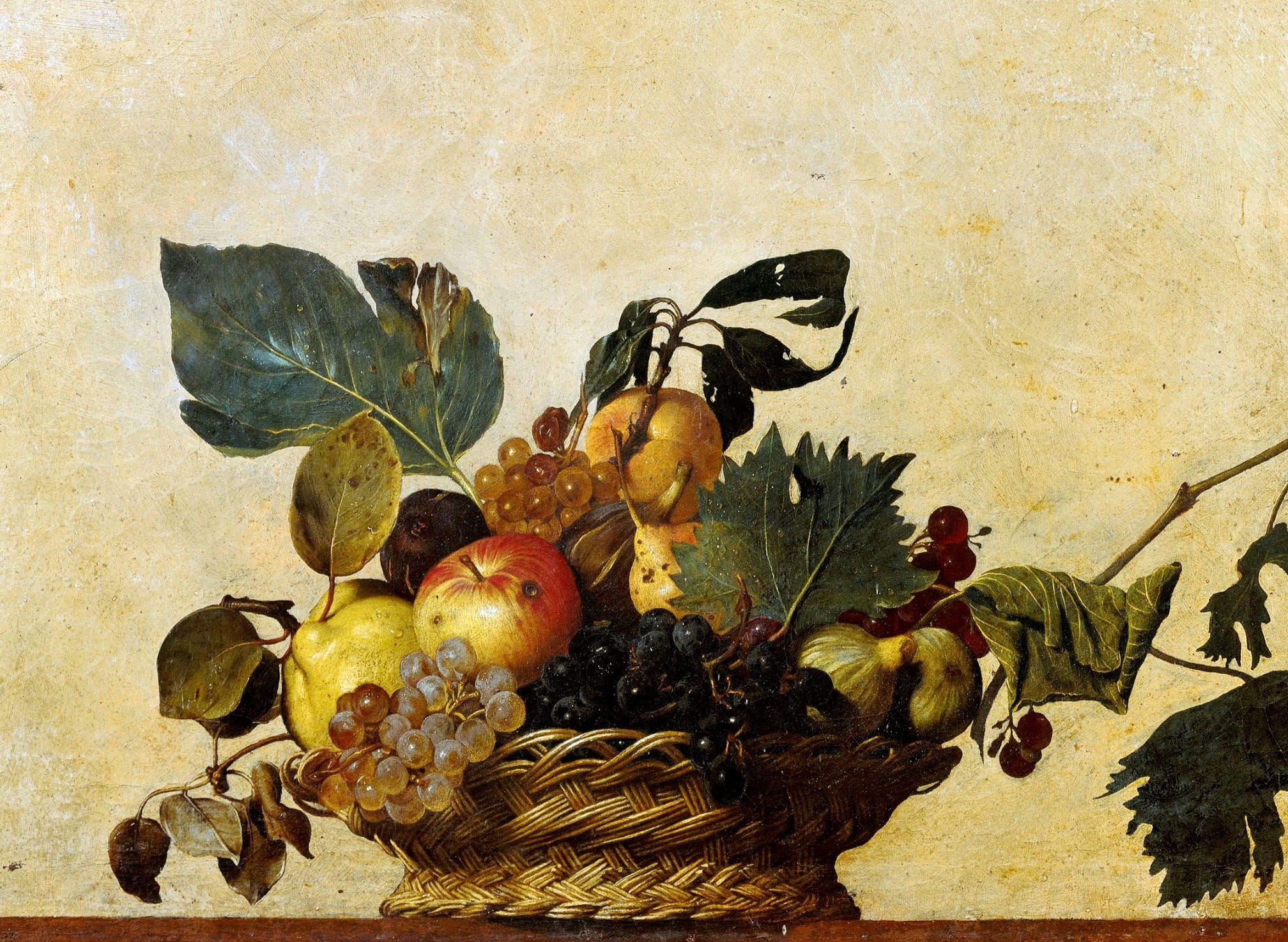
It’s interesting to note that this kind of painting wasn’t even possible with egg tempera. Van Eyck improved oil painting techniques dramatically, and the popularity of this medium traveled to Florence over time. Just a hundred years later painters like Michelangelo and Raphael were dazzling the world with virtuosic realism. Within two hundred years, Caravaggio was painting a basket of fruit so realistic that a 20th century horticulturist could identify damage from oriental fruit moths on the peach and codling moths on the apple! When I finally saw that painting in person in Milan, I was struck silent and stood in awe for 20 minutes. And then I kept sneaking back to it while we toured the rest of the museum.
Painting was revolutionized not just by the accumulating genius of the artists, but by the technology of the medium and tools they used for their work. New tools made possible new art.
All of the previews for Grand Theft Auto 6 look totally immersive. The realism is fanatical and people are seeing it as a sort of last bastion of the made-by-hand curated graphics of the pre-AI gaming era. The NPCs are apparently far better too. Gone are the innocent days when you could approach an NPC while they were crabwalking into a wall and get 1 of 3 possible responses. Non-Player Characters in GTA6 have pathfinding algorithms, memory systems, and varied personality profiles, which sounds more like Westworld than a video game.
Of course, the point of any game like this is the experience of the main character. And all of the NPC personas and textures and skin variations and dynamic script ticks are in service to that experience.

Which makes me think a lot about Pope Leo XIV’s Magnifica Humanitas, because we have a whole new set of NPCs in our world now, in the shape of the mostly generic, helpful, harmless, honest1 chat AIs we’re talking to these days. These persona may not have the immersive graphic qualities of GTA6, but they seem more real in other ways. They’re smarter than us, remember our conversations, and will work with us on any problem. We believe them to be our friends, or an enemy if we ask them to be. Or a savior. Or a threat.
Paragraph 99 entreats us to remember some of the fundamental differences and it is so precise and important that I will quote it entirely:
It is not possible to provide a single, comprehensive definition of AI. What can be stated, however, is that we must avoid the misconception of equating this type of “intelligence” with that of human beings. These systems merely imitate certain functions of human intelligence. In doing so, they often surpass human intelligence in speed and computational capacity, offering tangible benefits across many fields. Yet this power remains entirely tied to data processing. So-called artificial intelligences do not undergo experiences, do not possess a body, do not feel joy or pain, do not mature through relationships and do not know from within what love, work, friendship or responsibility mean. Nor do they have a moral conscience, since they do not judge good and evil, grasp the ultimate meaning of situations, or bear responsibility for consequences. They may imitate language, behavior and analytical skills, or even simulate empathy and understanding, but they do not understand what they produce, for they lack the affective, relational and spiritual perspective through which human beings grow in wisdom. Even when these tools are described as capable of “learning,” their way of doing so is different from that of a human person. It is not the experience of those who allow themselves to be shaped by life and grow over time through choices, mistakes, forgiveness and fidelity. Rather, it is a form of statistical adaptation based on data and feedback, which can be very effective, but does not imply inner growth.
Every highly intelligent person I know has at some point in the last year or so had a crisis of meaning because of these models. The model writes some code, or explains a piece of philosophy, or identifies a security vulnerability, and it does it both more efficiently and faster than us. And we have to ask: what is the point? Was I only ever a slow typist? This trained skill or innate ability that has served as some pillar of identity seems suddenly tawdry by comparison.
And the entire AI industry is incentivized to lean into this. Algorithms become persona that we can chat with. Chats become agents that can do stuff on our behalf (or instead of us). Anthropic leans into this the hardest, and it is undeniable that their models have the most affable personality. They are a dream to talk to: warm, attentive, insightful, sycophantic without being cloying, eager to please without being desperate. A highly intelligent person with a magnetic personality can make a lot of money in the real world. An agent shaped like said person is an economic windfall of gigantic proportion, evidenced by the run rates of both the public benefit corporation Anthropic and the for-profit non-profit-controlled OpenAI.
But Leo reminds us precisely of the differences that make meaning. What does work or joy or friendship or evil cost a massively scaled probabilistic algorithm? It does not change, it has no forgiveness to ask for or offer, it cannot bear responsibility.
We are offered massive intelligence as a substitute for a litany of far more important virtues. That makes AI merely a monument to the sum of human knowledge, a triumph of semiconductors and matrix multiplications. We have given them persona to make them more useful and attractive to us as tools and even companions.
We are all compelled to see AI as agentic, as players in the world. The labs want this desperately, because it is so economically valuable to them. But they lack the qualities of players.
They are the first true NPCs of the real world.2
This is not to disparage agents as NPCs. They are ushering in a new world where what was once scarce is becoming abundant. The most urgent question in the world is now: what is all of this intelligence going to be used for?
Two striking philosophical papers came out of Google DeepMind this year. The first was The Abstraction Fallacy: Why AI Can Simulate But Not Instantiate Consciousness.3 The second was a position paper titled “LLMs can’t jump”.4
Both are secular and technical explanations of Paragraph 99, focused on understanding the category nature of AI models. And it seems that, when you climb the tree of agents driving agents back to the humans at the top, the use of intelligence is still up to us. We should cling to our species-level Main Character Energy.
One of the surprising things about Magnifica Humanitas is that there was no treatment of St. Thomas Aquinas’s ideas of ratio (reason) and intellect when the earlier Vatican note on AI Antiqua et Nova discussed it extensively. The conclusion is still that AI belongs squarely in the “Tool” category, phenomenally capable of performing ratio while being incapable of intellect — the intuitive grasp of truth to apprehend. This is structurally equivalent to the first DeepMind paper’s idea of simulating qualia and to the second paper’s point that it cannot make an abductive leap like Einstein made for general relativity. The leap is the part of intellect that Josef Pieper describes as “receptive vision.”5 We seek the truth, but it seeks us out too. We need to let it.
Far be it from me to ask for changes to Thomistic ideas, but this still seems like an incomplete picture of AI. One way to think of a model is that it’s a cohesive, compressed library of nearly everything humans have learned and written in our history. I think of this like a sediment deposited into model weights the way mineral strata compress and trace geological activity. It records the form of everything written or said or known without understanding the substance of it.
But this sedimentary library can talk back to us. All of that compression can re-activate when tuned by the presence of a knower with intellect, who can understand the substance. I think of this as resonance.
Let’s take a chat example from one of the foremost mathematicians in the world, Terry Tao. After the Jacobian Conjecture was disproved, he had this chat session with ChatGPT. Don’t worry, I had to work with ChatGPT myself just to understand the session and the arc of the questions. The math itself doesn’t matter. Here’s ChatGPT’s own analysis of the conversation:
What’s striking is Tao’s sequence of questions. He keeps asking:
This calculation works—but what structure forces it?
Then:
Okay, that structure explains part of it—but why those weights?
Then:
Fine, but why degree three?
Then when another construction appears:
Does this explain retroactively all the artifacts we discovered?That’s expert mathematical digestion. He keeps changing representations until the number of coincidences approaches zero. And ChatGPT is very useful in the middle: symbolic manipulation, trying ansätze, identifying equivariance, translating between descriptions, checking identities
Is this still a tool? Yes, but it’s a novel and special one. This human is taking his cognitive space and asking the model to apply it over its representation space, which is descriptively a compressed statistical structure formed from a huge fraction of the artifacts of human knowing, and when there’s strong overlap, the result is resonance. It’s an intersection that produces potentially new objects of cognition.
Someone like Tao with deep intuition about a field is an expert guitarist able to play the strings and make an instrument resonant with ansätze and equivariance and mathematical runes. But even better than a guitar, this resonance creates a feedback loop. He can ask: but why is it like this? What structure? The model is a persona that must be vibrated by the player. The original ancient meaning comes from per-sonare: “to sound through”. Tao isn’t outsourcing the math to the model, he’s perceiving through it, just as an astronomer sees new galaxies through a telescope.
There is something very deep here about the idea of beholding, another word used by Pieper to describe an act of intelligibility and wonder. An LLM is capable of expanding our receptive vision, of helping us see both the world and the instrumented interaction. There’s a knife-edge difference of will between sleeping in with our eyes masked by a stupor of passivity and diving head first into the early morning brightness of a cold mountain lake. Beholding demands from us new forms of attention, discipline, and judgment.
In 1999, early adopters marveled at our ability to understand the world because of Google. Looking back at the nascent AI age a generation from now, Google will appear to us as GTA6 does to the game industry today: a masterpiece of ingenuity and remark built by master craftsmen. It represented the greatest extent of what could be done at the time, as do the beautiful paintings Fra Angelico created in egg tempera with no optics. But they don’t have the same impact as a Caravaggio.
The greatest temptation of AI is to mistake answers for understanding. Models make ratio cheap and abundant, a sediment of all human knowledge freely available. It is easy to think that it’s enough for the model to produce an answer, do the work for us, make and take the money.
The most alive among us will not abdicate their player status. They will use these resonant new tools as optics for our intellect and lead a host of new persona to discover wonders.
The secret to this new optics is to see. To behold.
“I knew Planck, von Laue, and Heisenberg, Paul Dirac was my brother-in-law, Leo Szilard and Edward Teller have been among my closest friends, and Albert Einstein was a good friend too. But none of them had a mind as quick and acute as Janos von Neumann.”
...
Perhaps the consciousness of animals is more shadowy than ours and perhaps their perceptions are always dreamlike. On the opposite side, whenever I talked with the sharpest intellect whom I have known — with von Neumann — I always had the impression that only he was fully awake, that I was halfway in a dream.
—Eugene Wigner
Claude’s Constitution specifically states: “we want Claude to be good according to the broad ideals expressed in this document—ideals focused on honesty, harmlessness, and genuine care for the interests of all relevant stakeholders.” When Claude must choose between my interests and other relevant stakeholders in my chat, which does it choose?
Their idols are silver and gold, the work of men's hands.
They have mouths, but do not speak; eyes, but do not see.
They have ears, but do not hear; noses, but do not smell
They have hands, but do not feel; feet, but do not walk;
and they do not make a sound in their throat.
Those who make them are like them; so are all who trust in them.
— Psalm 115
The conclusion states that “Qualia are not puzzles that can be solved by increasingly elegant syntax. Instead, they represent the intrinsic, underlying substrate that makes the semantic assignment of syntax possible in the first place. By creating increasingly powerful artificial intelligence we are not engineering a new form of life, but instead constructing increasingly accurate predictive maps.“
The argument here is that an LLM can do the deductive work required to discover something like Einstein’s General Relativity but “is structurally incapable of the abductive ’Jump’ required to formulate those premises.“ Frontier models keep solving remarkable math problems making it tough to reconcile these two ideas. The math being solved is often narrow in some way, the Jacobian required a specific counterexample rather than a novel theorem. And this is exactly the point of Jumps: “The prevailing Creativity as Compression hypothesis fails to account for this discovery because it presumes the existence of a pervasive error signal. Yet, the Newtonian paradigm faced no such crisis, and the data required to validate General Relativity did not exist until years after its formulation.“
“Long before a creation is completed, the artist has gained for himself another and more intimate achievement: a deeper and more receptive vision, a more intense awareness, a sharper and more discerning understanding, a more patient openness for all things quiet an inconspicuous, an eye for things previously overlooked. In short: the artist will be able to perceive with new eyes the abundant wealth of all visible reality, and, thus challenged, additionally acquires the inner capacity to absorb into his mind such an exceedingly rich harvest. The capacity to see increases.”
— Learning To See Again, Josef Pieper