

A few months ago, I woke up to a bunch of notifications because this happened:
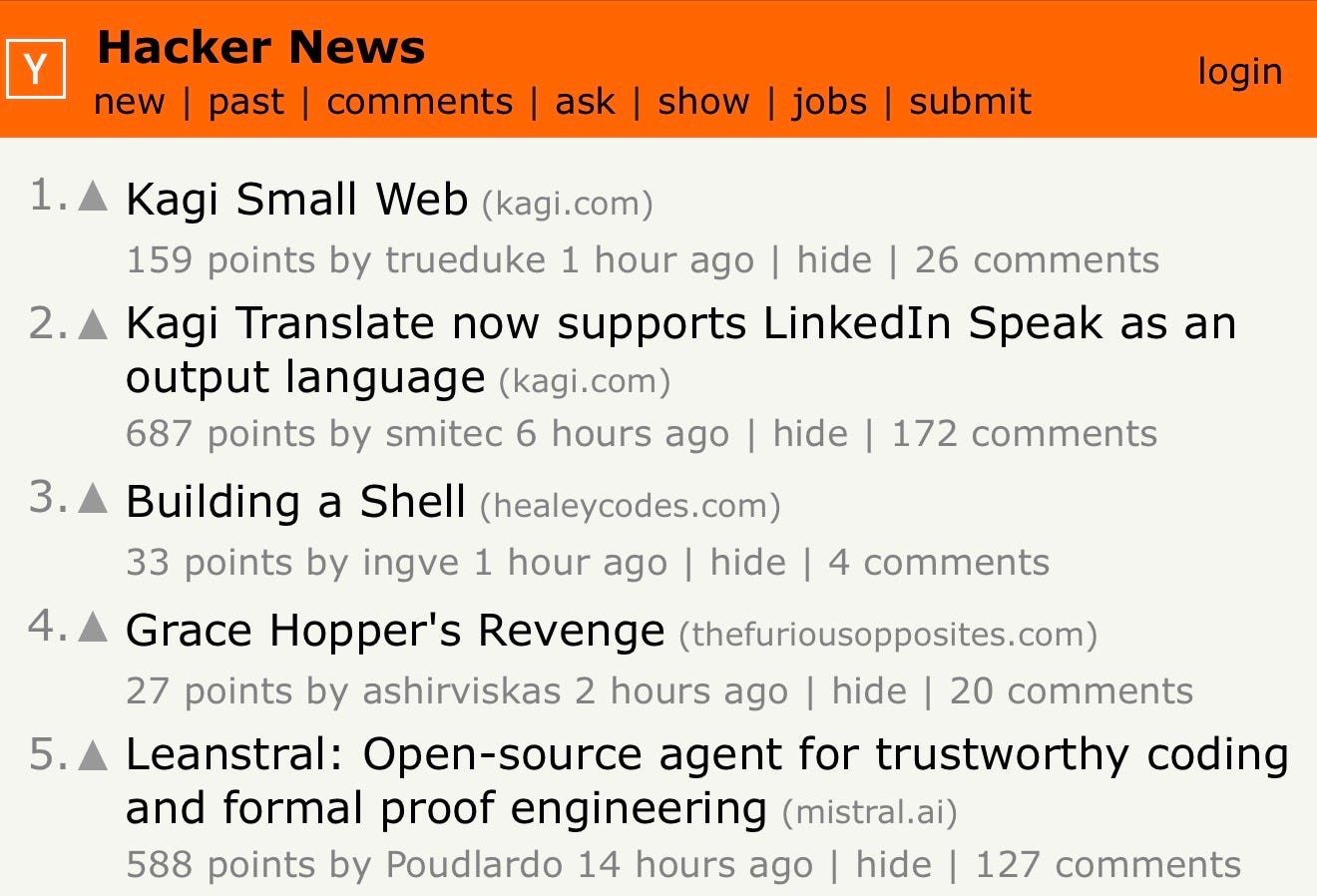
Readers here are pretty evenly distributed between people who read HN on a regular basis (including some who came from that blow-up, howdy howdy) and people that have never really heard of Hacker News. Let’s say it’s the nerd equivalent of an NYT editorial, even though the analogy doesn’t quite work, and leave it at that.
So that was fun and surprising. I didn’t post the article, someone else found it on Substack and posted it of their own volition. But before slapping “HN front page certified” on my resume, I decided to do the thing that all smart celebrities scream at you not to do. I read the comments.
And promptly ruined the rest of my day.
They were all: who posted this AI-slop drivel? Why does everyone write this way now? What horrid Claudish! (this was before Claudish was coined). But this is the new way to undermine anyone writing today: declare with no explanation or evidence that clearly this was AI-generated and therefore not worth your time.
So here’s the thing, we’ve all been experimenting with these things and figuring out what works and what doesn’t. You’d be foolish not to. A “load-bearing” and an emdash or two more than normal have probably seeped through my barriers. This is the point where I admit that, yeah, you’re damned right I used AI to help me write that. But not in a let-the-AI-think-and-output-for-me slop cannon kind of way. It was more like a help-me-find-my-words kind of thing and probably one or two sentences fell on through. Just recently, Stan Druckenmiller collaborated with an AI on an op-ed and said he was proud of it; the Atlantic called this a turning point. Meanwhile, Arthur Brooks says that letting AI write for you will make you sad.
So which is it? Normally, I’m quite aligned with Brooks on these things, but this time I’m an accelerationist. Of course you should use AI.
Things You Wouldn’t Write Otherwise
There are lots of things that I write with AI now that wouldn’t be written at all if I didn’t use AI. This is a function of how AI expands your ambition to do more things.
Here’s an obvious example: API docs. One of my new and unpublished projects is called Dobby. Dobby is a house elf for your house, running on top of Home Assistant. It’s for all the people out there that love the idea of a smart house but don’t want to waste a whole crap ton of time meticulously curating dashboards and configuration settings to get everything just right. So instead, they can waste a bunch of time configuring an LLM to live on top of all that stuff instead. It’s like OpenClaw for Roombas, and it works pretty well actually.
But Dobby is still a hobbyist project, which means it needs a bunch of API documentation and a user guide for setting things up and how you should configure your machine and specs and on and on. You think I want to write all that?
As DHH is fond of saying recently: look at all of the things I’m not doing. This is one of those things.
Dobby has an extensive user guide for you or your agent to read (your choice, really). I didn’t write it, Astra and Claude did. Does it matter that it doesn’t pass on Pangram? It does not. But there’s still some highly obvious tics that are nice to get rid of. For that I have the deslopify skill. This uses some excellent statistical work to eliminate or reduce obvious vocabulary and language patterns from the given text. It works decently, not decent enough to fool Pangram, which is bananas good, but good enough.
But that’s not the point. The point is, I didn’t want to write all this. I had so little interest that had there not been an AI to do it, it just wouldn’t have happened. And the world would have been poorer. Or the agents would have been, because we also need to get used to the idea that agents are as much of our audience as people.
When Writing Is Thinking
On the other hand, there’s a whole other kind of writing that is impossible to outsource. This is the kind that Stephen King talks about, that Paul Graham talks about, that seems to move the path of civilization forward in a fragile way as a form of telepathy.
I am not PG and I am certainly not Stephen King. After four and a half decades I’ve resigned myself to a much smaller pedestal and a smaller task. But I still want to follow their lead. Because they’re right about the method: writing is thinking. When you’re not sure what you think, writing is the absolute best way to figure it out. The goal of writing is clear thinking. So clear, in fact, that you can make it clear to others. If we want to maintain that standard, there’s a few ways to try AI without killing the thinking vibe.
The first is voice memos. STT models are incredible now. When I have a vague thought I want to start vaguely capturing as a vague ramble before a first draft, I dictate it into my phone. The specifics here don’t matter. Use OpenAI or Claude or any modern voice tool. I use Reflect App. If I’m on my laptop, I run NVidia’s Parakeet model locally and nothing ever leaves my box. The point is that you can ramble as long as it takes and capture it all clearly as text.
Then absolutely run it through a text AI model to get some variation of an outline. I call this outline archeology. You’re using all the pattern matching abilities to pull out themes from your long rambling note. Here’s an example of asking for that, a metaprompt since Claude refined it from my voice memo:
I’m thinking out loud. What you’ll get from me is raw brainstorming — voice memo transcripts, scattered notes, excited half-formed arguments — usually headed toward an essay or long-form piece. I generate ideas faster than I organize them, and I often say something important before I understand why it matters. Your job is to help me see what I’ve actually found, and give me a structure I can start writing from, without sanding off what makes the thinking mine.
But the biggest clear win is to turn AI into an editor instead of a writer. This takes more work, because AI is so eager to please. It wants to lighten your load and shoulder your burdens and rewrite for you. But You Must Not Let It.
This is my editor prompt, which I use only after I have a horrid but complete first draft down. Once that happens, the real work begins.
The editor is very specific. It must not inject its own voice or word choices. If I ask it for a specific word or synonym, it refuses and leaves it to me to figure out what the hell it is. I have begged and pleaded — “just give me this one sentence here!11! Please!” But it calmly tells me it trusts me to find the right metaphor. It will manage, rate, and ruthlessly judge what I’m doing. It finds logical errors, compares views, and encourages me to try again to get it right when it’s not. It’s relentless at all of that. But it does not write.
My editor gives my own thoughts more coherence. I’m able to find and replay thought processes I sometimes forgot. I have a constant sounding board to tell me when something probably isn’t right, but it’s a sounding board that does not try to insert adjusted opinions.
The Infamous Fifth Paragraph: A Conclusion and Restatement of the Thesis
So, yes, you should use AI to write. You should NOT let AI write for you, or think for you, or understand for you. But it will help you write and think and understand. It is a tremendous tool for this.
I probably need a more engaging conclusion. The AI said this was too short and boring, so let me add a bit more.
There’s a new movement from pro-humanist groups to eschew the use of AI at all. The most striking in my mind is the Association for Human Mathematics statement after OpenAI’s math dump, in which they said, “Mathematicians did not ask for this work to be done.” As if the point of mathematics is their well-being. There is a Catholic version of this too, the PAACCT, in which they reference both Leo XIV and St. John Henry Newman for authority.
There are still many scenarios where you should not use AI to write. The most obvious being those under 18 forming the earned ability to write and to think in the first place1. Academia is another, not because it would be wrong per se, but because that entire system is set up around credit and citation. Bullying anti-AI pledges are no different than the HN commenters disparaging my writing with a modern version of ad hominem: it’s just AI slop.
We are too shortsighted and fearful about our new tools.
Our understanding will evolve over time with grace, but for any thinking adult, the use of AI to write is a boon. I will defer here, instead, to another writer making a more poignant point. Michael Pakaluk said clearly of the Catholic anti-AI pledge, “Newman would not sign the AI pledge.”
I agree. Use the tools you have and learn to use them well.
One thought experiment for thinking about the importance of learning first without using AI tools is to invert the problem: consider the human as an input for the AI model to maximize. People need to be good enough to use the full measure of AI. Terry Tao uses the same models as you and I. The qualifying difference is he can make an AI resonant with more expert input.