

One of the biggest changes in a world full of AI is what it means to use leverage. Using AI well means having 10 arms and 20 legs and even a slightly enlarged brain. I always laughed at the whole “we only use 10% of our brains” thing but I’ve never known anyone to run out of space in their brains and suddenly it feels like there’s just a little more space in mine.
So I have been constantly searching for problem spaces as test harnesses for this new leverage. Lots of other curious people are doing the same. People are using background data and aircraft doppler signals to geolocate audio, finding unmapped Maya ruins in Mexico, breaking ciphers and reading letters from Napoleon’s generals, and building apps to locate a mysterious beep in your house.
This is apart from all the new math and the hacks, which we’ll get to in Part 2.
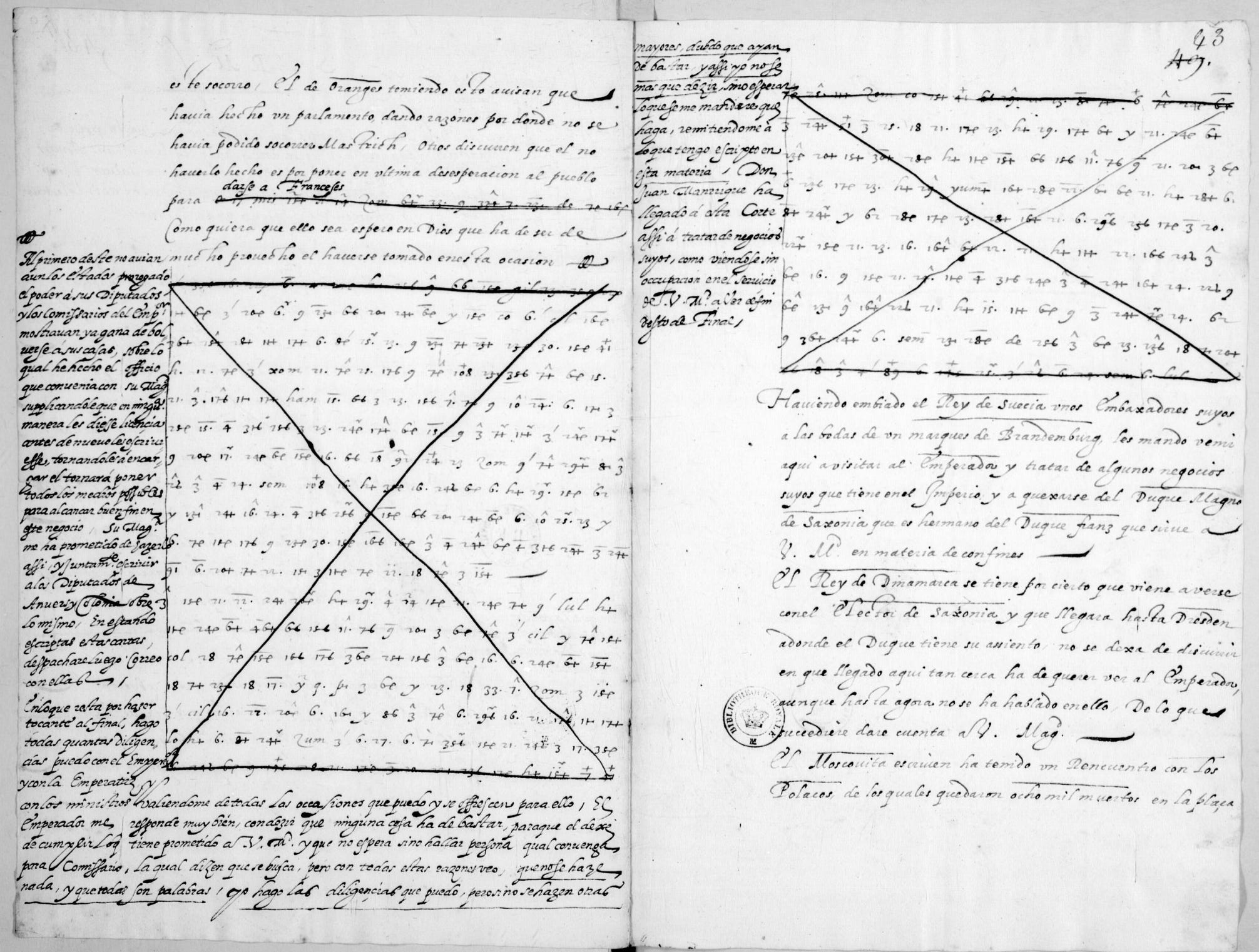
For my part, I’ve decrypted a series of letters between King Philip II and his Ambassador in Paris. As you’ll see, there is drama and intrigue and some new insights into the secret communication paths between Henri III and Philip.
Is it right to say I did this? Is this my work? Or Claude’s? Or both in resonance?
I was interested in finding problems that could be solved with the leverage of AI, so, with Claude, I built a repository of problems waiting for solutions. These aren’t just encrypted ciphers and mysterious manuscripts, but also earthquake and seismic data, USGS topographical data for orphaned oil/gas wells, and math conjectures.
I selected an identifiably solvable cipher. A researcher named Satoshi Tomokiyo had already done a lot of the hard key work a few years ago (Tomokiyo is using AI for his work now also). I then directed Claude to work systematically through the original pages and transcribe from cipher to Castilian to English.
After all of this work, it only seemed right that Claude should also write the narrative version. So it did, with some heavy editing from Astra and me along the way. Running it through Pangram gives fairly human results.

So, did I do this? I’m still not sure. Most of the heavy cognitive load fell on Claude. It wrote the Python scripts to make the glyphs on the page more legible. It deciphered the Castilian and translated to English. It also organized the project structure, managed the pages, handled the keys, and put the whole story together.
And yet.
The GPUs would not have whirred without my direction, and the prompting structure and problem modeling were a bit more complicated than “Decrypt this text, make no mistakes.” Perhaps that’s only an artifact of the rudimentary models of 2026. Maybe in 2027 I really will be able to simply say “Decrypt this cipher, make no mistakes” and poof!
We preach that AI cannot bear responsibility yet are eager to let it bear credit.
Model weights are not yet firing independent from the will of consciousness. And with that, I give you Claude’s excellent story of murder and deceit and conspiring Kings, with some details added for the first time since 1580.
Into My Hands
Philip II’s cipher letters and the fall of Antonio Pérez
Madrid, March 1578
Juan de Escobedo was stabbed to death in a Madrid street on the night of Easter Monday, 31 March 1578. He was secretary to Don John of Austria, governor of the rebellious Netherlands and half-brother of Philip II, King of Spain. Suspicion fell at once on Antonio Pérez, the King’s own secretary. In the standard account, Pérez arranged the killing with Philip’s authorization: poison failed twice, and hired swordsmen finished it. Who killed him is not much disputed. Why is the part historians still argue over.[1]
Philip wrote his instructions to Pérez in his own hand. We know the note through a copy presented in the murder proceedings. He calls Escobedo “el Verdinegro,” literally “the green-black one,” a name for a sour man capable of dark deeds:
“Cierto convendrà abrebiarlo de la muerte del Verdinegro, antes que haga algo con que no seamos despues a tiempo … Acedlo y daos priessa antes que nos mate.”
“Certainly it will be well to hasten the death of the Verdinegro, before he does something that leaves us too late … Do it, and hurry, before he kills us.”[2]
Pérez had served as secretary of state since 1567, succeeding his father.[3] Among the letters that passed through his hands were dispatches from Juan de Vargas Mexía, Philip’s ambassador in Paris. Vargas sent them to Pérez, and Pérez showed them to the King. Two weeks before the murder, Philip told Vargas that Pérez had shown him the ambassador’s report and papers on what one Diego de Alarcón was attempting. Pérez had also shown him Vargas’s account of affairs in France:
“Antonio Pérez me ha mostrado un discurso que l[e] haveys embiado sobre las cosas desse reyno.”
“Antonio Pérez has shown me a discourse that you sent him on the affairs of that kingdom.” (f. 34v)[4]
Between receipt and presentation there was room for the secretary’s judgment.[5] Vargas was also his friend, someone to whom he could write about his family and his troubles at court.
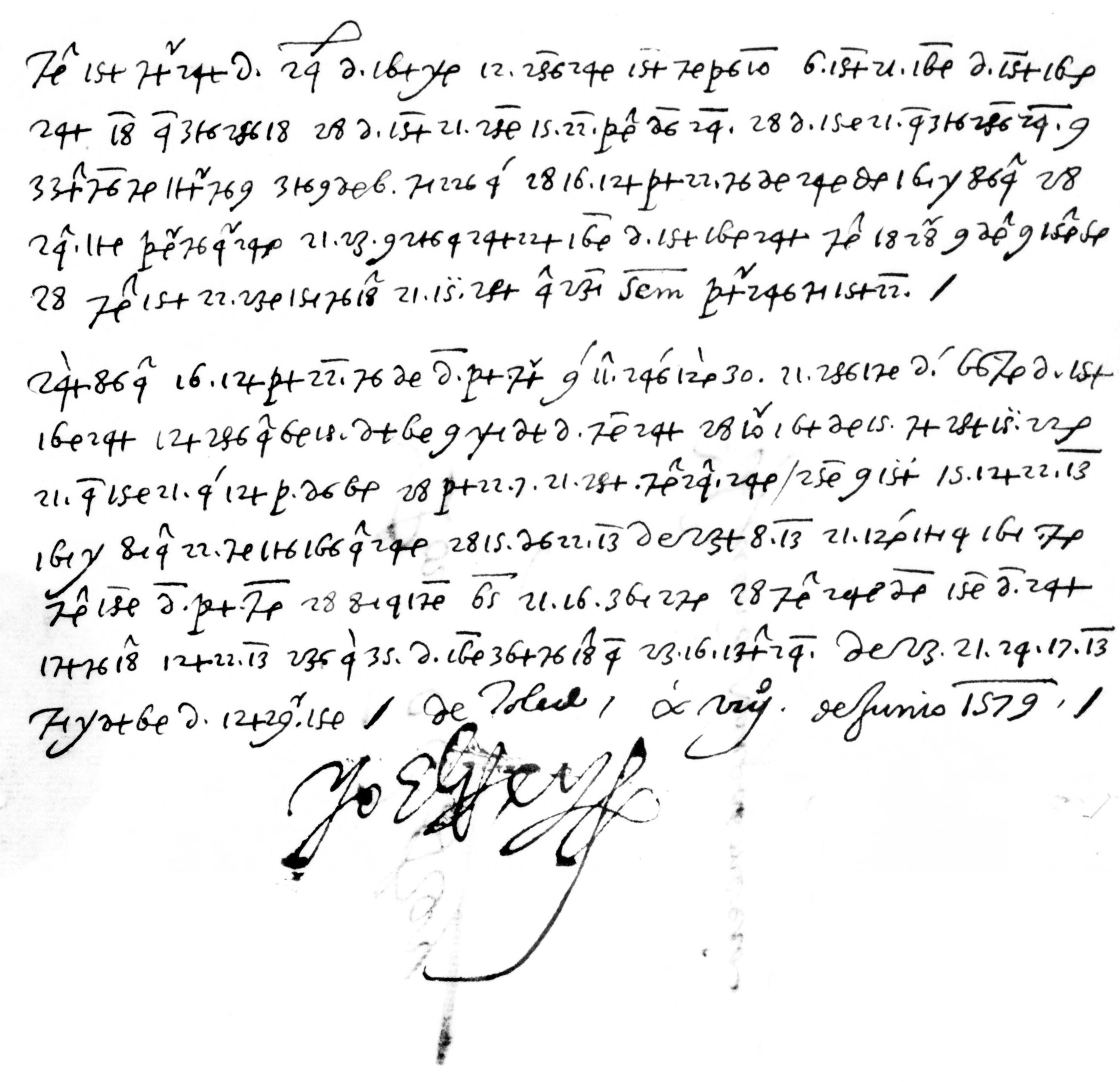
By the spring of 1579 the dead man’s family was pressing a suit, the King would not stop it, and Pérez was writing to Paris to explain himself. His letter survives in a volume at the Bibliothèque nationale de France, shelfmark Espagnol 132. It holds the correspondence Vargas received from Philip and Pérez between December 1577 and May 1580. Much of it is in cipher, sometimes for a few words in the middle of a sentence, sometimes for an entire letter. Pérez’s explanation is there, written three months before his arrest. For a long time, readers could follow him only as far as the numbers began.
Without the key
In 1844, the cataloguer Eugenio de Ochoa described letters written in conventional signs, mostly numbers arranged in a particular order, “que es imposible descifrar no teniendo la clave”: “which it is impossible to decipher without the key.” He could see where the cipher interrupted the prose: “precisamente cuando se va á hablar de materias delicadas” — “precisely when delicate matters are about to be discussed.”[6]
In 1950 the historian J.P. Devos published the Spanish diplomatic ciphers of Philip’s reign, three of this volume’s systems among them, without connecting them to it. In 2012 Samantha Rubino, an undergraduate at Ohio State, transcribed eight of Pérez’s letters from the volume. She thought the letter of 15 April 1579 might help explain the fall of Pérez, and most of what he says in it lay inside those brackets. In 2020 Satoshi Tomokiyo matched Devos’s three keys to the Paris volume and solved the fourth cipher himself.[7]
With a key, a line can be read in small pieces. Tomokiyo published a worked example from folio 81 (a folio is a manuscript leaf). These are its signs, rendered here in type:

“y por todas he visto lo que…” means “and from all of them I have seen what…” The number 24 supplies t; the hook beside it adds o. The number 6 supplies d, the plus sign adds a, and the bar adds s. Together the two groups make todas. Other signs stand for whole words: u. means que. The difficulty is often deciding what the scribe actually drew. The curl used for i, represented here by σ, can look like a joined numeral 6; reading it as another digit changes the result.[8]
We came to the volume in October 2026 with the published keys. Language models transcribed the page images sign by sign, without seeing the keys or one another’s answers. Programs then applied the keys, keeping the reading of the signs separate from the Spanish they would produce. Many letters were sent in duplicate, each copy enciphered separately, and nineteenth-century editors printed some of the King’s drafts; where we had either, we checked our reading against it.
Another project called cabinet-noir, also working with models, posted readings of thirty of these letters the same week. We found it after making our initial readings; where the projects overlap, ours are independent replications.[9] Tomokiyo had already read several words of Pérez’s April defence in 2020, including Escobedo’s name and the claim of innocence. Our readings and cabinet-noir’s have not been checked by a paleographer, a specialist in old handwriting, so the exact wording here is provisional. Gaps and uncertain readings stay marked.
On 16 October we read a further twelve royal letters for which we had found no earlier decipherment in the publications and repositories searched. Some of their business was known from summaries of Vargas’s dispatches; now we could read Philip’s replies. On 15 April 1578 he wanted Vargas to find out how many ships were being fitted out in France for the Indies route, where they would sail and what they were meant to do. He treated a Bordeaux proposal to seize the Prince of Béarn’s lands as a probe, telling Vargas to proceed with discretion. He approved Ayala’s arrest; the catalogue of Vargas’s letters describes the man as an apostate priest. In September he told Vargas to use the Archbishop of Nazareth, a papal envoy, to draw the Count of Lalaing away from Alençon, Henri III’s brother, and into Spanish service. The count could expect favours; the archbishop was to be encouraged with hopes of advancement. Philip ordered “muy gran secreto”: “the greatest secrecy.” (f. 85)[10]
In manuscript quotations, bold marks spans written in cipher, with the corresponding English also bold; ordinary handwriting stays in plain type. Brackets mark words supplied or uncertain in our reading. Bold does not mean first deciphered by us: some passages had already been read by others, and quotations taken from printed books are identified in the prose. The English translations are ours.[12]
Reports from Paris
Years after the murder, defending himself in the proceedings against him, Pérez gave reasons. One was that Vargas had reported a secret confederation between Don John and the Guises, a family of French nobles. He offered it among the causes that had led Philip to order Escobedo’s death. In 1846 the historian François Mignet checked the dates and threw the claim out. Pérez placed the warning around spring 1577, yet Vargas did not reach Paris until that December, and Mignet found that almost all his reports about the supposed understanding came after the murder.[13]
This volume holds the King’s replies to Vargas from exactly those months. On 24 January 1578 Philip acknowledged a report about Don John’s envoy, Alonso de Sotomayor, and his dealings with the Guises:
“y de todo lo [que] los Guysas trataron con él cerca del proceder de mi hermano y con Alanson … porque cierto son cosas que tienen mucha consideración.”
“and of everything the Guises discussed with him concerning my brother’s conduct and Alençon … for these are certainly matters that deserve serious consideration.” (f. 12v)
Philip was taking the report seriously two months before Escobedo died. Pérez countersigned the reply. Mignet dates Sotomayor’s mission to the Guises to May; this January letter records an earlier encounter.[14]
Other reports were more extravagant. In a February dispatch printed by Alexandre Teulet in 1862, Vargas passed on a story, through the Venetian ambassador, that the Scottish ambassador was working through the Guises to arrange Don John’s marriage to Mary, Queen of Scots. Don John would then take his army to England, with Guise assistance, and seize the kingdom. Vargas called these “grandes quimeras”: “grand fantasies.” Philip’s March reply judged the marriage talk “de poco fundamento”: “of little foundation.” That verdict is in cipher in the Paris volume, but Mignet had already printed it from the King’s draft. He still wanted to hear what people were saying, and he wanted Vargas to keep the Guises well disposed towards him.[15]
The words closest to Pérez’s story come from a dispatch of 13 April, also printed by Teulet from an official decipherment. Vargas had sat through a long talk with the Duke of Guise, who wished for “la union destas dos coronas” — “the union of these two crowns” — which together “podria dar ley al mundo, y partirsele entre sí”: “could give law to the world and divide it between them.” Mignet records Philip’s marginal “Ojo!”: look at this. The two crowns were Spain and France. Don John is not named in the passage, and Escobedo had been dead for two weeks.[15]
The January letter brings the dealings back before the murder, but it does not establish Pérez’s claimed confederation. No letter we can read from those weeks speaks of a league, a confederation or a union between them; the leagues mentioned in March concern other princes. Some March leaves are missing from the scan, and we have not read Vargas’s own dispatches, which are in the Spanish state archive at Simancas.
Through Pérez
In late April 1578 the French ambassador in Madrid proposed that Philip and Henri III act together against their rebels and against Elizabeth of England. He wanted to discuss it with Antonio Pérez. The proposal was to pass through very few hands, lest someone who learned of it obstruct it. The ambassador said he was acting on his own initiative, without orders from his king. Philip recorded what followed:
“Antonio Pérez me dio parte de todo lo que avía passado”
“Antonio Pérez reported to me everything that had happened.” (f. 41)
Philip welcomed the proposal and had Pérez carry his answer back. At a further meeting the question became how the ambassador should write to France about it. Pérez was Philip’s intermediary for the proposed approach to Henri III. Escobedo had been dead for four weeks.
Philip sent Vargas an account so that, if the matter came up in Paris, he would know how to answer. If no one mentioned it, however, the instruction was:
“no mostréis que sabéis nada della”
“do not show that you know anything of it.”
Vargas was also dealing with the Guises. Philip wanted the approaches kept apart, “sin que los unos sepan de los otros”: “without either knowing of the other.”[16]
The dead man’s papers
Don John died on 1 October 1578. Nineteen days later Philip wrote to Vargas in cipher about a matter they had been discussing. He allowed that the latest event, which we take to be his brother’s death, might have settled the matter:
“aunque con este último successo ha[n] cessado aquellas [dudas]”
“although with this last event those [doubts] have ceased” (f. 123)
He still wanted Vargas to find out:
“lo que en el negocio huviere passado, y hasta dónde se llegó en él, y las personas que en él intervenían … y aun si pudiéssedes aver algunos papeles o cartas del teatino o de otras personas, sería conveniente.”
“what had happened in the business, how far it had gone, and the people who had taken part in it … and if you could obtain some papers or letters from the Theatine or other people, that would be useful.” (f. 123)
The man called the Theatine in our reading remains unidentified. Vargas was to try to obtain the correspondence itself.
On 4 December he named the business. It was Guise’s dealings with Don John, reported to Vargas by the Scottish ambassador:
“la cifra que tenía con mi hermano, y lo que el mismo embaxador discurrió con vos de la unión que avía entre ellos, y el de Lorrena, y de los 800 mil ducados que tenían juntos.”
“the cipher he had with my brother, and what the same ambassador discussed with you about the union between them and the [Duke] of Lorraine, and the 800,000 ducats they held together.” (ff. 154v–155r)
The King wanted that report tested:
“el fundamento que tiene lo de los 800 mill ducados, y dónde y cómo los tienen, y si mi hermano avía recibido alguna parte dellos.”
“what basis there is for the matter of the 800,000 ducats, where and how they hold them, and whether my brother had received any part of them.” (f. 154)
The King added:
“sin que persona ninguna pueda entender que vos hazeys esta diligencia por orden mía.”
“without anyone being able to understand that you are conducting this inquiry by my order.”
The reported union here involves Guise, Don John and Lorraine. Eight months after Escobedo’s death, the King was still asking what basis the report had. His questions leave both the money and Don John’s receipt of it to be established. Our transcription of this letter has only one reader, though cabinet-noir’s separate reading supports its general content.[17]
Pérez countersigned the order. Four days later he wrote in his own name to repeat the request for papers, “con el mayor recato”: “with the greatest discretion” (f. 157) The man who would one day give Don John’s French dealings as a reason for the killing was passing on the King’s order to find out what they had been.
Only in the private letter
Vargas and Pérez exchanged news about their families as well as affairs of state. In September 1578 Pérez wrote to say he was sorry for the miscarriage of Vargas’s daughter-in-law, and reported on his own household.[18] Before leaving Madrid in 1577, Vargas had named Pérez an executor of his will. He also provided that, if no member of his own family survived to use an educational trust, Pérez’s sons could benefit from it.[19]
In January 1579 Pérez gave his friend instructions about the handling of letters. He assured him that there was care over papers, and said that sensitive material should come by a particular route:
“solo venga en la [carta] particular … y con esta forma no avrá peligro.”
“let it come only in the private [letter] … and in this way there will be no danger.” (f. 179)
He explains that someone has too much business to examine all the letters. Who that person is remains unread. We cannot yet tell whether Pérez meant the King or another official.[20]
Stay where you are
Pérez began his letter of 15 April 1579 in clear Spanish, acknowledging that Vargas would have heard the rumours.
Rubino had transcribed this opening in 2012:
“Porque no dudo sino que avrá llegado por allá la grita y mentiras que han corrido por aquí estos días de cosas mías, diré aquí brevemente a V.m. la verdad de lo que passa, por su satisfación.”
“Since I do not doubt that the outcry and lies circulating here these days about my affairs will have reached you, I will tell you briefly the truth of what is happening, for your satisfaction.” (f. 198)
Much of that promised truth follows in cipher. Philip, he says, had meant to give him an office, which he calls the office “de Vargas”: “of Vargas. We cannot securely identify the office or the Vargas attached to it. Pérez names the three men the King had told to organise the office: “el Marqués de los Vélez, Quiroga y [Chinchón].” Quiroga was the Archbishop of Toledo; the Count of Chinchón is reported to have opposed Pérez’s claim to the post.[21] All Madrid said the place was his. Then the King held back and decided to divide it. The cause, in Pérez’s account, was “la demanda que Escovedo me puso” — “the suit Escovedo brought against me.” Juan de Escobedo was dead; his eldest son, Pedro, and his widow were pressing the family’s suit. Pérez says the suit ended with his innocence established, and blames the false testimony and the time spent investigating it for his loss of advancement.[22]
In his later defence, Pérez said the Marqués de los Vélez had backed Escobedo’s killing, declaring that even “with the Host in his mouth” he would name Escobedo as the man to sacrifice. Mignet, following Pérez, dates the remark to Holy Thursday, 27 March 1578, four days before the murder. Los Vélez died before the arrests, “full of suspicion and sadness,” in Mignet’s words.[23]
Pérez calls the loss of the office a public blow. The King should have rewarded him, he writes, “honrrarme y acrecentarme para reparo de mi honrra y testimonio de mi inocencia”: “to honour and advance me, to repair my honour and bear witness to my innocence.” Being, he says, a “filósofo, como V.m. sabe” — “a philosopher, as you know” — he has asked to withdraw from service and live a quiet Christian life. He wants to leave the people who “me han procurado quitar la honrra y la vida”: “have tried to take my honour and my life.” Out of that request “el [diablo] y sus ministros,” “**the [devil] and his ministers,” have made the rumour that he is to be banished. Then comes the assurance:
“la verdad es que V.Magd no me ha querido dar licencia; antes dessea que yo me sossiegue y esté quedo.”
“The truth is that His Majesty has not wished to give me leave; rather he wishes me to calm myself and stay put.” (f. 199r)
According to Pérez, the King had the Archbishop of Toledo ask the Princess of Éboli, Pérez’s ally at court, to persuade him to remain. The archbishop had sworn great oaths that the King would feel his going. If Pérez went on serving, “dexándome en manos de V.Magd” — “leaving myself in His Majesty’s hands” — there would be favours and honours. This intervention rests on the provisional reading of this letter; we found no separate historical source confirming it.[22]
Philip’s own note to Pérez from the same month comes from a different manuscript, quoted by Mignet in 1846. It was already in print; we did not recover it from cipher. Pérez had complained that the King was avoiding him and had asked him to stop the Escobedo family’s prosecution. Philip put their fewer meetings down to his Easter devotions. He would not halt the proceedings, and gave his reason:
“mientras se pueda escussar que lo que se ha hecho de la muerte de Escobedo no asido con interbencion mia, bien será que se escusse … y assi os ruego mucho que os aquieteis y sosegaeis.”
“so long as it can be maintained that what was done in the death of Escobedo was not by my intervention, it is well that it be maintained … and so I beg you earnestly to quiet yourself and be calm.”[24]
The same verb, sosegar, to calm or settle, is in both. We do not know which letter came first. Philip tells Pérez that he will not protect him from the prosecution, because protecting him would show the King’s hand in the killing. Pérez tells his friend that the King values him too much to let him go.
Pérez tells Vargas the suit has ended with his innocence established; in the exchange Mignet dates to April, he is asking Philip to stop it. In his later account, Pérez says Antonio Pazos, President of the Council of Castile, told Pedro de Escobedo that Pérez and Éboli were “sin culpa como yo”: “as blameless as I am.” Pedro gave his word “por mi, por mi hermano y por mi madre” — “for myself, my brother and my mother” — to speak no more of his father’s death against either of them. Mateo Vázquez, another royal secretary and Pérez’s enemy, found another relative to keep pressing the King.[25] The son’s withdrawal could explain Pérez’s claim that the suit had ended, while Vázquez’s pressure would explain his appeal to Philip. The account is Pérez’s own, and Mignet gives no date for it.
Pérez ended by saying he did not know how the business would turn out. He promised Vargas news, then returned to ordinary handwriting and his family. This farewell, too, was already in Rubino’s transcription:
“Doña Juana y nuestros hijos tienen salud y besan las manos de V.m. muchas vezes.”
“Doña Juana and our children are well and kiss your hands many times.” (f. 199r)
Another hand
Pérez and Éboli were arrested on the night of 28 July 1579. By the King’s order the Archbishop of Toledo went to console Doña Juana.[1]
As recently as 13 July, Philip had written to Vargas, in clear Spanish, “Antonio Perez me ha mostrado la carta”: “Antonio Pérez has shown me the letter.” (f. 215) Pérez signed that one beneath the King.
The next royal letter to Vargas in the file is dated 24 August. It is written entirely in clear Spanish, and no secretary signs beneath the King. Philip does not mention the man he had ordered arrested less than a month before. He writes that Vargas’s letters have come “a mis manos”: “into my hands.” (f. 218)[5] Philip tells Vargas to stay in Paris until Don Juan de Idiáquez arrives, or until he receives other orders. Idiáquez had been named to replace Vargas as ambassador. He never went: by 13 September he was signing Philip’s letters as secretary in Pérez’s place, and that month’s cipher tells Vargas to expect a letter from him.[26]
By October Philip acknowledges, again in clear Spanish, the letters Vargas has directed “a mis manos, como a las de Çayas”: “into my hands, as well as those of Zayas.” (ff. 228/231) Zayas was the other secretary of state. Pérez’s part in receiving and presenting Vargas’s correspondence is gone from what Philip writes.
We read every dated royal letter to Vargas from 24 August 1579 through May 1580 and found no reference to him, to Éboli, to Escobedo, or to Pérez’s papers. A brief reference could still lie in a disputed or unread passage; the witnesses do not agree on every word. Vargas’s own dispatches are known to us chiefly through printed excerpts and catalogue summaries. The silence belongs to this side of the correspondence, as far as we can read it. It shows what the King chose to write to Paris, and leaves open what Vargas already knew.[26]
A paper in Paris
Philip continued to ask for news from Paris. Twice that autumn he wanted to know how news had travelled the other way.
One inquiry concerned talks he had himself encouraged. In March 1579 he had told Vargas to keep a negotiation with the French courtier Lansac going: “pues desto no se puede seguir ningún inconveniente” — “since no harm can come of it.” Captain Cabreta had arrived in Madrid with “grandes offertas”: “great offers.” (f. 185) By September Lansac’s men had been sent off. (ff. 220/224)[27]
In September he asked in cipher about information reaching the French ambassador in Madrid “de las cosas de acá”: “about affairs here.” If Vargas knew where it came from, he should say. Philip asked whether an informant had named someone or given a more definite indication; the damaged wording leaves the reference uncertain. (ff. 222/226) Then he named the negotiation:
“La plática que Lansac ha tenido acá, no sé cómo se aya podido entender allá”
“The negotiation Lansac has had here, I do not know how it can have come to be known there.”
The sentence continues with Philip wondering whether Lansac himself had chosen to disclose it.[28] In November the inquiry concerns a document. A paper had reached Paris and was passing as the Council of War’s opinion about Portugal. Vargas sent it to Philip, who compared it with opinions submitted to him by private individuals and recognized it as one of those: “del consejo no lo es” — “it is not the Council’s.” Vargas was to find out:
“con destreza por qué vía y medio ha ido a parar allá este papel.”
“with skill, by what route and means this paper has ended up there.” (ff. 245/247)
Neither letter establishes who passed the information.[29]
The ambassador’s copies
The French ambassador Philip was asking about was Saint-Goard. His papers, now in Paris, contain fifty-three copies of Spanish state papers on the Portuguese succession.[28] On 12 November 1579 he wrote to Henri III in ordinary script:
“ayant recouvert les pappiers qui accompaignent ceste cy”
“having recovered the papers that accompany this letter”
He could send them safely, he added, only “par homme exprès et de confidance”: “by a special and trusted man.” The latest paper in the batch reached Madrid on 28 October. Fifteen days later a copy was on the road to France.
Among the copies is Vargas’s own dispatch from Paris of 24 August 1579, deciphered in Madrid and marked received on 4 September. Nine days after that date, Philip asked him where the French ambassador got his knowledge of affairs in Madrid.
Several of the copied papers name Zayas, the other secretary of state. Notes of receipt, copied with the texts, show that the copyist worked from papers already filed. None of the copied papers names Pérez. The copies trace the papers to an office, though they do not identify the person who passed them to Saint-Goard. Saint-Goard’s dispatches for most of 1579 are missing from the file, so we cannot tell when the copying began.[29]
Saint-Goard’s packet of 7 February 1580, which reported the death of the King of Portugal, was opened at Burgos. He was told that someone had tried to decipher it, failed, and sealed it again. He complained to Zayas, who called it a stupidity of the corregidor of Burgos.[30]
Pérez was held for years. He was tried for corruption and then for the murder, tortured in 1590, and escaped that April to Aragon and the next year to France. He died in Paris in 1611.[31]
Vargas did not live to see those trials. In 1580 he revised his will; Pérez was no longer an executor, and his sons no longer stood to benefit from the trust. Nothing we have read says why.[17] Vargas was buried in the second half of that year. The embassy papers were in the care of his executors, and Philip’s nephew, the Prince of Parma, asked that they be kept safe. Julián Paz’s catalogue summarizes the instruction with the words “sin comunicarlos a nadie”: “without sharing them with anyone.”[32]
The letters are in Paris still, scanned, where anyone can look at the numbers.
For historians and cryptographers
The complete repository and artifacts for this work.
The volume and the keys
The manuscript is BnF Espagnol 132, available on Gallica (PRIMARY). Folio references above use its written foliation; r and v designate the front and back of a leaf. The digital images are spreads, and their sequence numbers differ from folio numbers. The scan omits ff. 26v–31r, including the rest of a March 1578 letter and its duplicate. The undated f. 273 is an Italian Savoy memorial copied for Vargas, now read by two witnesses; it is outside the series of royal letters.
Cipher numbers follow Tomokiyo (SECONDARY technical account). He identified Ciphers 1, 3 and 4 among keys printed in J.-P. Devos, Les chiffres de Philippe II (1950), and solved Cipher 2 in August 2020. Devos reconstructed Cipher 4 from Vargas’s letter of 16 May 1579. Cipher 3 is the system designated Cp.30; cabinet-noir reports its nomenclature, or whole-word codes, in Alcocer’s 1921 publication as well as Devos. We have not inspected Alcocer’s printed table directly.
Notes
Modesto Lafuente, Historia general de España, XIV, ch. 22 (SECONDARY), text; the Escobedo summary (SECONDARY, drawing on the 1911 Britannica). For Philip’s own words, see notes 2 and 24.
Mignet, pp. 88–89 and p. 88 nn. 2–3 (SCHOLARLY, printing a PRIMARY note), printed page, citing “Copia de un billete para Antonio Perez de mano Su Magestad presentado para declaration de la muerte d’Escobedo,” Hague ms. f. 77. Only the copy is known to us; neither it nor an original has been inspected. The gloss on “Verdinegro” follows Mignet’s note 2. Spanish checked against the page image, including “abrebiarlo” and “Acedlo” (hacedlo); the ellipsis omits “quel no deve de dormir ni descuidarse de sus costumbres.” This passage was found in Mignet, not in Espagnol 132.
Pérez’s appointment in 1567 in succession to his father, and Zayas as the other secretary of the Council of State: Martínez Navas, p. 141 (SCHOLARLY); Mignet (SCHOLARLY);
sources/history-2026-10-04.md§1.1–1.2.F. 34v, 16 March 1578, countersigned by Pérez (PRIMARY), Gallica, view 32. Quotation follows cabinet-noir, result 15 (CLAIMANT). Our exp 06 decodes contain the damaged discourse passage (A, numbered lines 45–46; B, 40–41); the earlier statement that we had not read the letter was wrong. Exact joined wording and “l[e]” remain theirs; “en lo de la ci[fra]” is not used.
BnF Espagnol 132, ff. 206, 215, 218 (PRIMARY), Gallica. Countersignatures checked against images;
analysis/07-after-arrest/countersignatures.md.Eugenio de Ochoa, Catálogo razonado de los manuscritos españoles… (1844), pp. 220–224 (SECONDARY catalogue), text.
Tomokiyo’s account and keys (SECONDARY); Samantha R. Rubino, The Secrets of Antonio Pérez Decoded (2012), supervised by Geoffrey Parker, especially the transcriptions in Appendix I (SCHOLARLY undergraduate thesis), Ohio State.
F. 81 specimen after Tomokiyo;
overview-build/template.htmlandsources/transcription/CIPHER3-GUIDE.md. PRIMARY signs as transcribed; SECONDARY key identification.canon.md, “Prior scholarship”; cabinet-noir (CLAIMANT). Comparative results and their limits appear below and in experiments 06–07.Ff. 37, 85 (PRIMARY, provisional), Gallica; exp 09,
reading_f37.md,reading_f85.md; Paz K 1548 for f. 37’s business. Papal envoy: Ivan Cloulas, “La diplomatie pontificale médiatrice…” (1969), p. 451 (SCHOLARLY). That article establishes the archbishop’s mission; its later pages were not inspected. No earlier decipherment of these letters was found in the experiment’s search.F. 181 (PRIMARY, provisional), Gallica; exp 09,
reading_f181.md, paragraphs 2–3. The joined reading follows B where the witnesses differ; agreement is 85% of A and 66% of B. No claim that these were already agreed peace terms.Typographic distinctions and prior readings:
essay/QUOTES.md. PRIMARY manuscript passages remain provisional; historical print sources and model-produced CLAIMANT readings are distinguished there. Bold marks cipher spans, including bracketed editorial supplies, rather than guaranteeing every supplied letter. “Escovedo” follows the quoted sources; the narrative uses “Escobedo.”François Mignet, Antonio Perez et Philippe II (1846), pp. 68–73, 434–439 (SCHOLARLY, reporting Pérez’s CLAIMANT account), text.
F. 12v (PRIMARY, provisional reading); Mignet p. 436; Julián Paz, Catálogo IV: Secretaría de Estado (1914), p. 382, K 1543 (SCHOLARLY finding aid), catalogue. Paz describes the Sotomayor–Guise conference as concerning French resentment of Don John’s manner of writing to the court.
Alexandre Teulet, Relations politiques de la France et de l’Espagne avec l’Écosse au XVIe siècle, V (1862), pp. 137, 145 (PRIMARY texts in a scholarly edition), text; Mignet pp. 437, 439;
analysis/06-premurder/teulet-check.md.F. 41 (PRIMARY, provisional), Gallica; exp 09,
reading_f41.md, paragraphs 2–5. Two blind readers, 92% / 94%; the day is unresolved (29 April in Tomokiyo). Saint-Goard is the identification by date, not a name read in the cipher. Paz K 1546 independently lists the league negotiation. The ambassador’s own-initiative qualification matters: Henri III’s authorization is not established. His dispatch remains unchecked.Ff. 123, 154, 157 (PRIMARY, provisional readings);
analysis/05-cipher4-v2/readings-v2.md. Don John’s death:sources/history-2026-10-04.md§7, citing John of Austria (SECONDARY). In f. 123 our decode leaves the noun after “aquellas” unread; “[dudas]” follows cabinet-noir’s reading (CLAIMANT), which has “abrán cessado” where ours has “ha[n] cessado.” That the “último successo” is Don John’s death is our inference (H6 inhypotheses.md).F. 87 (PRIMARY, mostly clear text);
OVERVIEW.md§4.Rubino, pp. 15–16, 27–28 (SCHOLARLY undergraduate thesis), citing printed will clauses in Álvarez y Baena; originals not inspected. Her proposed explanation of the revision remains an inference.
F. 179 (PRIMARY, provisional reading);
analysis/05-cipher4-v2/readings-v2.md; H7 inhypotheses.md.F. 198r (PRIMARY, provisional). Our readers leave the third name unresolved (“Quiroga y cli n cl” in
analysis/05-cipher4-v2/readings-v2.md); “[Chinchón]” follows cabinet-noir’s reading (CLAIMANT), which they mark as an ad hoc reading of one sign group. Quiroga’s see:sources/history-2026-10-04.md§4.1. Vélez and Quiroga as Pérez’s supporters for the vacancy of Diego de Vargas, and Chinchón among his opponents: es.wikipedia, “Antonio Pérez del Hierro” (SECONDARY), as recorded insources/history-2026-10-04.md§9.1–9.2 with its dating problem.Ff. 198–199 (PRIMARY; Pérez’s assertions are CLAIMANT evidence);
analysis/05-cipher4-v2/readings-v2.md, with clear passages inanalysis/02-key-extensions/reading-f198-v1.md. Éboli context:sources/history-2026-10-04.md§3, including Martínez Navas (SCHOLARLY). Pedro de Escobedo as the eldest son, and the memorials of son and mother: Mignet, p. 126 (SCHOLARLY), printed page. Cabinet-noir reads “P[edro]” before “Escovedo” in f. 198; the initial is their supply, so the name rests on Mignet.Mignet, p. 88 and p. 89 n. 1, citing Pérez’s Memorial, p. 317 (SCHOLARLY, reporting Pérez’s CLAIMANT account), printed page; Mignet, p. 133 and n. 3, on the marquis’s death, printed page. Mignet’s note quotes a letter from Los Vélez to Pérez of 26 January 1579 that calls absence from court his only consolation; when the three men met over the office is not stated. Checked against the page images.
Mignet, p. 120 n. 2 (SCHOLARLY, printing a PRIMARY note), citing Hague manuscript f. 101; printed page. Quotation checked against the image, including “escussar,” “no asido” and “sosegaeis”; the original Hague manuscript was not inspected.
Mignet, pp. 126–128 (SCHOLARLY), quoting Pérez’s Relaciones, pp. 13–14 (CLAIMANT), printed page; Spanish checked against the page image. Pazos was also bishop of Córdoba:
sources/history-2026-10-04.md§2.4. Mignet says the King set the family’s later petitions aside and the courts took up the case only ten years afterwards.Ff. 218, 220/224, 228/231 (PRIMARY);
analysis/07-after-arrest/README.md, results and log;canon.md, “After the arrest.” Idiáquez’s appointment context rests on secondary accounts listed there.F. 185 paragraph 2 (PRIMARY, provisional; “Lansac” supplied from “iansac” in both decodes), and ff. 220/224, Gallica; exp 09 and exp 07. Lansac’s identity: Guy de Saint-Gelais (SECONDARY). The letters do not connect these talks to Pérez.
Ff. 222/226 (PRIMARY), second decodes, numbered lines 27–34; cabinet-noir also reads Lansac’s talks (CLAIMANT). Longlée is a candidate for the preceding name, not an identified source. The secondary account attributes the investigation by Longlée to Ribera and disclosure by Philip to Le Roux. Neither book was inspected; Philip’s question complicates the latter account without settling it. H18’s test is Saint-Goard’s dispatches.
Ff. 222/226, 245/247 (PRIMARY, provisional readings);
analysis/07-after-arrest/README.md; Paz, K 1554–55, as recorded insources/paz-1579-1580.md(SCHOLARLY finding aid). Paz lists a Council of War report on means of taking Portugal in the event of war, possibly the leaked paper; the original has not been inspected.BnF Français 16106, ff. 210–391 (PRIMARY);
analysis/10-saint-goard/index-*.tsvandanalysis/11-mole/papers.tsv,counts.txt(59 documents, 53 state papers; the count rests on one model reader’s index of the spreads). Gachard, La Bibliothèque nationale à Paris, vol. 2 (1877), pieces LIX–CXV (SCHOLARLY), as recorded insources/saint-goard-prior-publication-2026-11-10.md. “No one” describes our recorded search; Gellard, Ribera, Vázquez de Prada and Valladares were not reached.12 November 1579: fr. 16106 f. 359r (PRIMARY, ordinary script; one reader, working reading), printed by Gachard as piece CXV. Latest paper: Vázquez and Molina, 25 October, with its note of receipt. Vargas’s dispatch: ff. 231–232v (heading and note of receipt read on the image); when the copy was made is not known; whether it is the letter Mousset cites as AN K 1557 n° 110 is open. Álava: ff. 210r–215v,
sources/alava-advice-1579-05-28.md; H21 inhypotheses.mdis open, and the test is the opening of the copy in AGS Estado K 1554–55. Zayas:analysis/11-mole/README.md; H22. The countersignature is on Philip to Vázquez and Molina, 26 August 1579. Only six dated papers precede Pérez’s arrest, so the file cannot show whether copying began before it. Villeroy letter: BnF Français 16107 f. 85r, 20 February 1580 (PRIMARY; one reader),sources/fr16107-source-hunt-1580.md. The friend in that letter reports on Philip’s printed book about his claim. The missing 1579 dispatches:sources/saint-goard-1579-dispatches-search.md.BnF Français 16107 f. 83r, Saint-Goard to Villeroy, 20 February 1580 (PRIMARY; one reader, working reading),
sources/fr16107-source-hunt-1580.md. The account of the opening is Saint-Goard’s own.Custody, the corruption review of 1584, the murder prosecution from 1585, torture and flight to Aragon in 1590, flight to France in 1591: Martínez Navas (SCHOLARLY), Lafuente (SECONDARY);
sources/history-2026-10-04.md§1.4–1.5, §11.2. Death in Paris in 1611: PARES authority record (SECONDARY archival biography); the disputed day is not needed here.Paz, K 1558, 1580 summaries (SCHOLARLY finding aid);
sources/paz-1579-1580.md§3. Illness and a codicil appear in the first half-year’s summary, burial in the second; Rubino’s conflicting 1581 death date is not followed.BnF Français 15561, ff. 42–43 (PRIMARY); exp 08,
score_A_p34.txt,score_B_p34.txt. Primary scores merge the continuous decipherment across the page boundary. The margin transcription is itself model-produced; the original scoring amendment and weaker short passages remain in the record.